
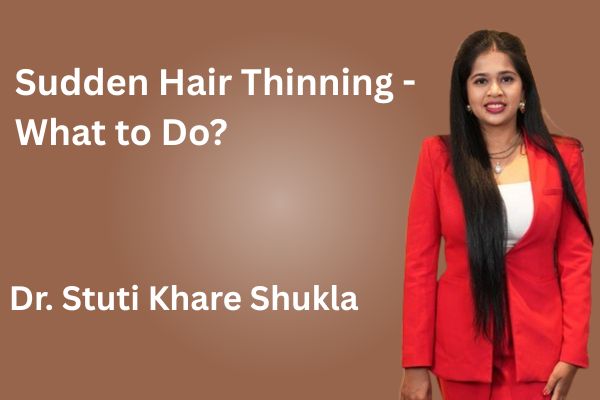
Sudden Hair Thinning – Noticing a sudden change in hair density can be worrying. You may see more hair on your pillow, in the shower, or on your comb, while your parting or scalp may become more visible. Sudden Hair Thinning can happen for several reasons, and understanding the underlying cause is an important first step toward better hair health. Dr. Stuti Khare Shukla’s website highlights hormonal changes, nutritional deficiencies, stress, genetics, scalp concerns, and external hair damage among the common factors associated with hair fall and thinning.
Sudden Hair Thinning: Could Hormones Be the Reason?
Hormonal changes can significantly influence the hair-growth cycle. Thyroid disorders, PCOS, pregnancy, postpartum changes, menopause, and other hormonal fluctuations may contribute to increased shedding or thinning. These changes can shift more hair follicles into the resting or shedding phase.
If Sudden Hair Thinning appears alongside irregular periods, hormonal symptoms, postpartum changes, or other health changes, discussing these concerns with a dermatologist can help identify possible contributing factors.
Sudden Hair Thinning: Is Your Diet Affecting Your Hair?
Hair follicles are sensitive to nutritional changes. According to Dr. Stuti’s website, deficiencies involving iron, vitamin D, zinc, B vitamins, and protein can contribute to increased hair shedding and weaker hair. Crash diets or inadequate protein intake may also affect hair quality.
A balanced diet with adequate protein, vegetables, fruits, legumes, nuts, seeds, and other nutrient-rich foods can provide important nutritional support. If a deficiency is suspected, appropriate testing and professional guidance can help determine whether supplementation is needed.
Sudden Hair Thinning: Can Stress Trigger It?
Stress is another important factor to consider. Prolonged emotional, physical, or lifestyle-related stress can affect the normal hair-growth cycle. More follicles may prematurely enter the resting phase, followed by noticeable shedding weeks or months later. This pattern is commonly associated with telogen effluvium.
Poor sleep, irregular routines, and excessive workload can further affect overall wellbeing. Maintaining adequate sleep, hydration, regular meals, physical activity, and stress-management practices can support healthier hair cycles.
Sudden Hair Thinning: Could It Be Genetic?
Genetic or pattern hair loss can gradually reduce hair density. In androgenetic alopecia, susceptible follicles can progressively become smaller and produce finer hairs. Thinning may appear around the crown, parting, or hairline depending on the individual pattern.
Early assessment is useful because identifying pattern thinning at an earlier stage allows a dermatologist to understand the progression and develop an appropriate personalized plan.
Sudden Hair Thinning: Don’t Ignore Your Scalp
Scalp health is an important part of maintaining healthy hair. Dandruff, excess oil, inflammation, buildup, and other scalp concerns can affect the environment around hair follicles. Dr. Stuti Khare Shukla emphasizes scalp hygiene and appropriate scalp care as part of a comprehensive approach to hair health.
Gentle cleansing, avoiding excessive product buildup, and addressing persistent scalp concerns can help create a healthier environment for hair.
Sudden Hair Thinning: Check Your Hair-Care Habits
Sometimes hair may appear thinner because of breakage rather than only follicular shedding. Frequent colouring, chemical processing, excessive heat styling, and tight hairstyles can weaken the hair shaft and increase breakage.
Reducing excessive heat and chemical processing, avoiding hairstyles that constantly pull on the roots, and choosing gentle hair-care practices can help protect existing strands.
Dr. Stuti Khare Shukla – A Specialist in Hair Growth
Dr. Stuti Khare Shukla is an MD Dermatologist, founder of Elements of Aesthetics, and a specialist in non-surgical hair growth treatments and clinical dermatology.
Her awards and recognitions include Youngest Dermatologist of India and Young Dermatology Icon (2017), Power Woman of India and Specialist in Non-Surgical Hair Restoration (2020), ET Inspiring Women Award and Times Healthcare Leader of India (2021), Leading Icon Award in Hair Growth Treatment (2022), Big FM Best Dermatologist of India, Asia’s Healthcare Leadership Award, ICEDATHON Innovator in Trichology, and BW Healthcare 40 Under 40 (2023), followed by the Women Super Achiever Award, Times Network Best Trichologist, Navabharat Best Trichologist, and other professional recognitions in 2024.
She has also been a TEDx speaker and a jury member and hair care expert at Femina Miss India.
Her approach focuses on understanding the underlying cause of hair loss rather than treating every case in the same way. Factors such as nutrition, hormones, stress, genetics, scalp health, and lifestyle are considered when evaluating hair thinning.
Sudden Hair Thinning – When Should You See a Dermatologist?
If Sudden Hair Thinning continues, becomes increasingly noticeable, or is accompanied by significant shedding, visible scalp, receding areas, or patches, professional evaluation is recommended. A dermatologist can review your medical and lifestyle history, examine the scalp and hair pattern, and determine whether factors such as nutritional deficiencies, hormonal changes, stress, genetics, or scalp conditions may be involved.
Dr. Stuti Khare Shukla Contact Information
Social Media Links:-
More Ways to Contact:-
Conclusion
Sudden Hair Thinning does not always have one single cause. Changes in hormones, nutrition, stress, genetics, scalp health, and everyday hair-care habits can all influence hair density and the normal hair-growth cycle.
Instead of immediately changing multiple products or trying random remedies, start by understanding what may be causing the change. Maintain a balanced diet, support healthy sleep and stress-management habits, take care of your scalp, and avoid excessive heat, chemicals, and tight hairstyles.
If thinning persists or becomes more noticeable, consulting a dermatologist can help identify the underlying cause and guide you toward a personalized hair-care plan. Early attention to Sudden Hair Thinning can be an important step toward maintaining healthier hair and supporting long-term hair health.
Related Tags:-
- best hair doctor in India
- hair growth queen of India
- dermatologist for hair growth
- best hair treatment in Mumbai
- non surgical treatment for hair loss
- Hair Growth Booster®
- Awards and Achievements
- Best Hair Fall Treatments in India
- Hair Transplant
- Hair Transplant vs. Hair Growth Booster®
- How to Stop Hair Loss in Women Naturally
- Top 5 Causes of Sudden Hair Loss
- Hair Growth Results
- Teenage Hair Fall Treated Without Surgery
- Dry Hair After Wash
- Keratin Treatment
- The Dark Side of Daily Heat Styling
- Coloured + Damaged Hair
- Hair Oiling
- Hair Colouring Safe
- SKS Hair Growth Booster
- Hair Transplant vs. SKS Hair Growth Booster
- Balding or Thinning
- Real People Real Results
- Treatment At Home
- Best Dermatologist for Hair Growth in India
- Non-Surgical Hair Regrowth Solutions
- Patients Avoid Hair Transplant Surgery
- Top Hair Loss Myths
- Common Causes of Hair Fall
- Hair Grow Faster After Postpartum Hair Loss
- Best Hair Growth Foods for Indian Women
- hair falling out at 25
- Hair Growth Specialist in Hyderabad
- Men Experiencing Early Baldness
- Proven home remedies for thinning hair
- Can stress cause hair loss
- Hair Fall During Summer Season
- Hair Transplant vs Non-Surgical Hair Growth Treatments
- Gen Z loosing hair very early
- Boost Hair Growth After Chemotherapy
- Why People in Metro Cities Loosing Hair
- Hormonal Changes After Childbirth
- Hair Loss During Menopause
- India’s Hair Growth Queen
- Female Pattern Baldness
- Male Pattern Baldness
- Telogen Effluvium (TE) and Hair Shedding
- Best Hair Doctor in Mumbai
- Hair Growth Gummies
- Best Hair Doctor in Hyderabad
- Hair Loss Treatments in India
- Hair Thinning Treatment in India
- Hyderabad IT Sector People Are Losing Hair Early
- Model or an Actor in Mumbai
- Best Hair Doctor in Nagpur
- Hair Loss at the Crown
- Hair Getting Thinner
- Hair Follicle Health
- Can Weak Hair Become Strong Again
- Hair Growth Cycle
- Hair Growth Has Stopped
- Sudden Hair Thinning