
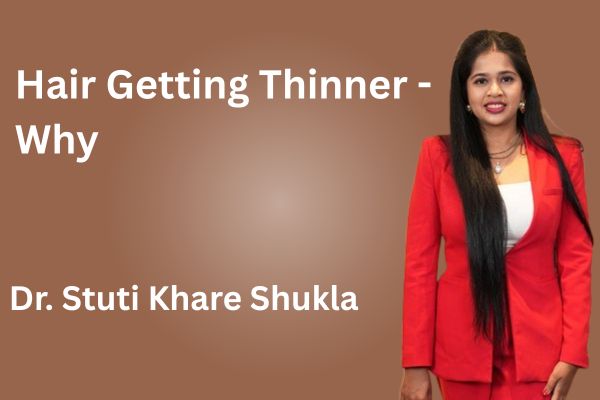
Hair thinning is a common concern for both men and women. You may notice that your ponytail feels smaller, your scalp is becoming more visible, your hair part is widening, or your overall hair volume is gradually decreasing. But Hair Getting Thinner does not always mean that you are going bald. It can be linked to several factors, and identifying the underlying cause is an important first step.
According to information shared by Dr. Stuti Khare Shukla, hair thinning can be associated with genetic factors, hormonal changes, nutritional deficiencies, stress, scalp health, and external hair damage. A proper assessment can help determine what is affecting your hair growth cycle.
Hair Getting Thinner: What Does It Actually Mean?
When hair becomes thinner, individual strands may become finer and overall density may decrease. In pattern hair loss, follicles can gradually become smaller, producing finer hair over time. This process is known as follicular miniaturization.
Women may commonly notice a widening centre part or reduced volume around the crown, while men may notice thinning around the hairline or crown. However, the pattern can vary considerably from person to person.
Why Is Your Hair Getting Thinner?
There is rarely one universal reason for thinning hair. Some of the commonly discussed causes include:
Genetics and Pattern Hair Loss
Family history can play an important role. Genetic or pattern hair loss can gradually affect follicle size and hair density. Early recognition is important because addressing thinning earlier may provide more options for management.
Hormonal Changes
Hormonal fluctuations associated with conditions such as thyroid disorders, PCOS, pregnancy, postpartum changes, and menopause can influence the hair growth cycle. If thinning begins alongside other hormonal symptoms, professional evaluation may be appropriate.
Nutritional Deficiencies
Hair growth requires adequate nutrition. Insufficient protein, iron, vitamin D, zinc, and certain B vitamins may contribute to increased shedding or weaker hair. Addressing an identified deficiency can be an important part of a comprehensive hair-care plan.
Stress and Lifestyle
Chronic stress, inadequate sleep, irregular routines, and major lifestyle changes can affect the normal hair growth cycle. Stress can trigger telogen effluvium, a form of increased shedding that may become noticeable weeks or months after a stressful period.
Hair and Scalp Care
Frequent colouring, harsh chemical processing, tight hairstyles, excessive heat styling, and poor scalp care can contribute to hair shaft damage and breakage. Maintaining a healthy scalp environment and following gentle hair-care practices can help protect existing hair.
Hair Getting Thinner: When Should You Consult a Specialist?
If your hair is gradually becoming thinner, early evaluation can be useful. You should consider consulting a dermatologist if you notice persistent shedding, increasing scalp visibility, a widening hair part, receding areas, sudden thinning, or patchy hair loss.
A specialist may review your medical and family history, scalp condition, lifestyle, nutrition, and other possible triggers. Depending on the situation, appropriate investigations may also be recommended.
The goal is not simply to treat the visible hair loss but to understand what is affecting the follicles and hair-growth cycle.
Hair Getting Thinner: Supporting Healthier Hair Growth
Simple lifestyle measures can support overall hair health. These include maintaining adequate protein and nutrient intake, getting sufficient sleep, managing stress, keeping the scalp clean, avoiding unnecessarily tight hairstyles, and limiting excessive heat or chemical processing.
For persistent or significant thinning, dermatologist-guided treatment may be considered. Dr. Stuti Khare Shukla’s website highlights personalized, non-surgical hair-growth approaches for patients experiencing hair fall and thinning.
Dr. Stuti Khare Shukla: Specialized Hair Growth Care
Dr. Stuti Khare Shukla is an MD Dermatologist and founder of non-surgical hair growth treatment and Elements of Aesthetics. Her official website describes her as the Hair Growth Queen of India and highlights her specialization in hair growth and clinical dermatology. She was also awarded Young Dermatology Icon in 2017.
Her approach focuses on understanding hair loss and developing individualized care for patients. Her website also showcases patient experiences and hair-growth results, including cases involving thinning and different forms of hair loss.
Dr. Stuti Khare Shukla Contact Information
Social Media Links:-
More Ways to Contact:-
Conclusion
If you notice your hair getting thinner, don’t immediately assume that permanent hair loss is inevitable. Thinning can have several possible causes, including genetics, hormones, nutrition, stress, scalp concerns, and hair-care practices.
Understanding the reason behind the change is the first step. A consultation with a qualified dermatologist can help identify the contributing factors and determine an appropriate approach for your individual hair and scalp needs.
With specialized experience in hair growth and non-surgical hair restoration, Dr. Stuti Khare Shukla focuses on personalized care for people dealing with hair fall and thinning.
Related Tags:-
- best hair doctor in India
- hair growth queen of India
- dermatologist for hair growth
- best hair treatment in Mumbai
- non surgical treatment for hair loss
- Hair Growth Booster®
- Awards and Achievements
- Best Hair Fall Treatments in India
- Hair Transplant
- Hair Transplant vs. Hair Growth Booster®
- How to Stop Hair Loss in Women Naturally
- Top 5 Causes of Sudden Hair Loss
- Hair Growth Results
- Teenage Hair Fall Treated Without Surgery
- Dry Hair After Wash
- Keratin Treatment
- The Dark Side of Daily Heat Styling
- Coloured + Damaged Hair
- Hair Oiling
- Hair Colouring Safe
- SKS Hair Growth Booster
- Hair Transplant vs. SKS Hair Growth Booster
- Balding or Thinning
- Real People Real Results
- Treatment At Home
- Best Dermatologist for Hair Growth in India
- Non-Surgical Hair Regrowth Solutions
- Patients Avoid Hair Transplant Surgery
- Top Hair Loss Myths
- Common Causes of Hair Fall
- Hair Grow Faster After Postpartum Hair Loss
- Best Hair Growth Foods for Indian Women
- hair falling out at 25
- Hair Growth Specialist in Hyderabad
- Men Experiencing Early Baldness
- Proven home remedies for thinning hair
- Can stress cause hair loss
- Hair Fall During Summer Season
- Hair Transplant vs Non-Surgical Hair Growth Treatments
- Gen Z loosing hair very early
- Boost Hair Growth After Chemotherapy
- Why People in Metro Cities Loosing Hair
- Hormonal Changes After Childbirth
- Hair Loss During Menopause
- India’s Hair Growth Queen
- Female Pattern Baldness
- Male Pattern Baldness
- Telogen Effluvium (TE) and Hair Shedding
- Best Hair Doctor in Mumbai
- Hair Growth Gummies
- Best Hair Doctor in Hyderabad
- Hair Loss Treatments in India
- Hair Thinning Treatment in India
- Hyderabad IT Sector People Are Losing Hair Early
- Model or an Actor in Mumbai
- Best Hair Doctor in Nagpur
- Hair Loss at the Crown
- Hair Getting Thinner